China’s digital motor-control sector spans compact drives, integrated servo systems, and controllers built for demanding industrial environments. This introduction examines how manufacturers differentiate their products through control accuracy, thermal design, communication options, and application support. Buyers should look beyond catalog claims. A polished brochure proves little.
Dr. John Chiasson is an electric-machine control researcher and author. A concise paraphrase of the engineering principle reflected in his published work is: “Reliable control begins with a sound model and careful measurement.” That distinction matters on a factory floor, where a controller must respond to changing loads, heat, vibration, and operator settings. A useful comparison therefore asks how manufacturers validate performance, document operating limits, and support commissioning—not simply which company advertises the highest specifications.
The coming sections outline practical criteria for assessing China-based suppliers, including product range, customization, quality processes, and technical service. They also consider how a Digital Motor Controller fits into a complete drive system, from motor feedback to the host machine’s control network. Request test data for the intended motor and duty cycle. Check whether the stated accuracy applies under realistic conditions. Small details matter: connector access, cooling clearance, and readable fault codes can shape maintenance time. Even strong suppliers may leave questions unanswered. Treat that uncertainty as a reason to verify, not assume.
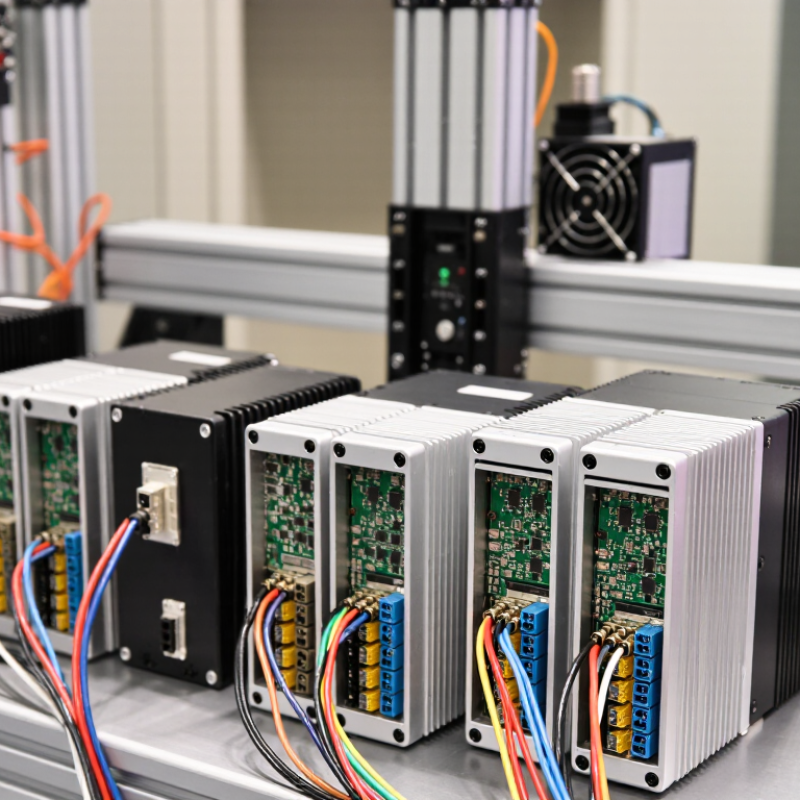
A digital motor controller is an electronic unit that regulates a motor’s speed, torque, and direction. It receives a command, such as a speed setting, then adjusts electrical power to match. Unlike a simple on-off switch, it can respond continuously to changing loads. The exact functions depend on the motor type and controller design.
Inside, power transistors switch current rapidly through the motor windings. Pulse-width modulation changes the effective power delivered, while a control circuit manages switching timing. Some controllers use encoder or Hall sensor feedback; others estimate rotor position from electrical signals. The controller compares the requested speed with measured or estimated speed, then adjusts its output. It may also limit current to reduce overheating during a heavy start. A bench test can still surprise you: wiring layout and cooling often affect performance more than a tidy diagram suggests.
Tips: Check the controller’s voltage, continuous-current rating, motor compatibility, and feedback method before comparing suppliers in China. Test under the expected load, not only at idle. Small details matter. A current rating alone does not guarantee reliable operation in a warm, enclosed cabinet.
China’s digital motor controller industry is moving from basic speed regulation toward connected, feedback-based control. On factory floors, controllers read encoder signals, adjust torque, and flag overheating before a production line stops. The International Energy Agency estimates that motor-driven systems use about 45% of global electricity, making efficiency a practical industrial priority. China’s Ministry of Industry and Information Technology set targets in its 2021–2023 Motor Energy Efficiency Improvement Plan: annual output of 170 million kW of high-efficiency motors and annual electricity savings of 20 billion kWh. These were targets, not proof of results. That distinction matters.
The market spans low-voltage variable-frequency drives, servo systems, and compact controllers used in pumps, fans, machine tools, and production equipment. Large integrators may specify control systems for whole lines, while smaller suppliers often compete through customization, delivery speed, and sensor integration. Buyers assess more than rated power. They check response time, overload capacity, communication protocols, heat dissipation, and access inside crowded electrical cabinets. Automation and energy-saving retrofits support demand, but legacy motors and inconsistent commissioning can limit digital functions. Progress is uneven. A controller may collect precise data, yet poor installation can make those readings less useful. This gap is easy to underestimate.
China’s leading digital motor-controller manufacturers often focus on distinct application needs rather than making one controller for every motor. Some specialize in compact BLDC and PMSM controllers for pumps, fans, and small electric vehicles. Their strengths may include configurable current limits, Hall-sensor or sensorless operation, and compact boards that fit tight enclosures.
Other manufacturers concentrate on industrial AC drives or servo controllers. These products may support encoder feedback, precise speed adjustment, and communication with factory control systems. For example, a packaging line may need steady low-speed torque, while a ventilation unit may prioritize quiet operation and energy use. Fit comes first. Product labels can sound similar, but control modes, cooling design, and overload ratings differ. The market is not perfectly uniform, so published specifications deserve careful checking.
Tips: Match the controller to the motor’s voltage, rated current, and feedback type. Ask for test data under realistic loads, not just peak ratings. Also check wiring diagrams and thermal limits. A small mismatch can mean extra heat or unstable operation.
Typical Motor Controller Specialties
This technical overview shows common motor types served by digital controllers and their typical number of controlled output channels. These are representative configurations, not manufacturer rankings or market-share figures.
Digital motor controllers translate software decisions into precise torque and speed. Their core technologies include pulse-width modulation, closed-loop feedback, and sensorless vector control. Encoders can track shaft position; current sensors help controllers detect overloads and adjust output. In pumps, fans, and compressors, variable-speed control can match motor output to demand instead of throttling flow mechanically. Small adjustments matter. In factories, coordinated drives support conveyor timing and smoother starts, reducing mechanical shock to belts and gearboxes.
The International Energy Agency’s 2011 report, Energy-Efficiency Policy Opportunities for Electric Motor-Driven Systems, estimates that motor-driven systems use about 45% of global electricity. The U.S. Department of Energy’s motor-systems sourcebook reports that they account for roughly 69% of U.S. manufacturing electricity use. These figures show why control design matters, but they are not guaranteed savings for any one site. Results depend on load profiles, installation, and maintenance. Heat still matters. A controller running in a dusty cabinet may need careful cooling and protection, while a clean laboratory test can miss that reality. Engineers should compare measured energy use, operating temperature, and response under actual working conditions—not just headline efficiency ratings.
When comparing Chinese motor controller manufacturers, match each supplier’s capabilities to the motor, load, and operating environment you actually need. Start with application details: voltage range, continuous and peak current, cooling method, enclosure rating, and control protocol. Ask for test reports showing temperature rise, efficiency, overload response, and performance across the stated operating range. A controller that works on a bench may behave differently inside a sealed machine cabinet. Request sample units and repeat tests under your own conditions. Test it yourself. Numbers can mislead.
Check whether drawings, firmware revisions, and inspection records use consistent version control. Confirm who handles component changes and how you will be notified before production. Look for clear answers on engineering support, spare parts, lead times, and warranty boundaries. Ask for a small pilot run before committing to larger volumes. Factory visits or live video inspections can help verify assembly steps, calibration equipment, and final testing. A polished catalog is not proof of stable production. Supplier data may not reflect your installation, so leave room for uncertainty. Choose a manufacturer that shares evidence, explains limitations, and responds with specific corrective actions.
| Assessment Dimension | Comparison Data to Collect | How to Assess | Evidence to Request |
|---|---|---|---|
| Motor Compatibility | Supported motor types, such as induction, permanent-magnet synchronous, and brushless DC; supported feedback devices and sensorless modes. | Confirm the controller supports the specific motor design, feedback method, and control mode required by the application. | Model-specific datasheet, supported-motor list, and motor commissioning instructions. |
| Electrical Ratings | Rated input voltage and frequency; continuous and peak output current; rated power; overload duration; braking and regeneration ratings. | Compare ratings at the intended supply voltage and ambient conditions. Check whether current and power ratings are continuous or temporary. | Datasheet rating tables, derating curves, and overload-time curves. |
| Control Performance | Available control modes, speed range, speed regulation, torque-control capability, response time, and stated accuracy. | Compare figures only when test conditions, motor type, feedback device, and measurement method are specified consistently. | Performance specifications, test conditions, and application test results. |
| Digital Interfaces | Available interfaces and protocols, such as CANopen, Modbus, EtherCAT, PROFINET, or Ethernet-based interfaces; digital and analog I/O count. | Verify the exact protocol version, supported functions, connector pinout, and compatibility with the intended PLC or network. | Communication manual, protocol conformance information, and interface wiring diagram. |
| Protection and Diagnostics | Documented protections for overcurrent, overvoltage, undervoltage, overtemperature, short circuit, and motor or feedback faults. | Check which faults are detected, how the controller responds, and whether fault codes and event logs are available. | Protection-function list, fault-code guide, and diagnostic software documentation. |
| Environmental Limits | Operating and storage temperature, humidity limits, altitude limits, cooling method, and enclosure protection rating. | Match the published limits to the installation environment. Confirm any derating requirements for temperature, altitude, or restricted airflow. | Environmental specifications, derating curves, and enclosure test documentation. |
| Safety and EMC | Declared safety and electromagnetic-compatibility standards, applicable product scope, and any functional-safety features. | Check that certificates or test reports apply to the exact controller model and intended use. Relevant standards may include IEC 61800-5-1 for electrical, thermal, and energy safety of adjustable-speed drive systems and IEC 61800-3 for EMC requirements. | Current certificates, test reports, declarations, and the model numbers covered by each document. |
| Reliability and Quality Control | Published service-life assumptions, component or product test procedures, production inspection steps, and traceability arrangements. | Assess whether reliability statements identify test conditions and whether production checks are documented and repeatable. | Quality-system certificates, inspection plans, sample test records, and serial-number traceability details. |
| Software and Commissioning | Configuration software availability, parameter backup and restore, firmware update process, and commissioning support. | Evaluate ease of setup, access to parameter documentation, and the process for recovering or updating a controller. | Software guide, parameter list, firmware procedure, and sample commissioning checklist. |
| Customization and Supply | Available hardware or firmware customization, stated production lead time, minimum order quantity, and spare-parts availability. | Compare written commitments for the required configuration and order volume; distinguish standard products from engineering projects. | Written quotation, configuration specification, lead-time confirmation, and after-sales terms. |
| Application Validation | Results from testing with the intended motor, load profile, supply, communications network, and operating environment. | Prioritize representative application testing over comparisons based only on headline ratings or unqualified performance claims. | Test plan, measured results, test setup description, and acceptance criteria. |
| Comparison Note | Controller specifications vary by model and configuration. Record the exact model, revision, test conditions, and document date for every comparison; do not treat unverified or non-model-specific claims as confirmed ratings. | ||
It regulates a motor’s speed, torque, and direction by adjusting electrical power. Unlike an on-off switch, it can respond as the load changes.
Power transistors switch current through the motor windings. Pulse-width modulation changes the effective power, while a control circuit manages switching timing.
Encoders or Hall sensors can report rotor position. Some controllers estimate position from electrical signals instead. Feedback helps adjust output when actual speed differs from the requested speed.
Match its voltage, continuous-current rating, motor type, and feedback method to your application. A current rating alone is not enough.
Idle tests may miss extra heat, unstable operation, or weak low-speed performance. Try the controller in realistic conditions. Wiring matters, too.
They can control pumps, fans, compressors, conveyors, packaging lines, and small electric vehicles. The required control features vary by application.
It can match motor output to changing demand, rather than relying on mechanical throttling. Actual savings depend on the load, installation, and maintenance.
Warm air, dust, and limited cooling can raise operating temperatures. A clean bench test may not reveal those problems. I may be overlooking a site-specific detail.
A Digital Motor Controller regulates a motor’s operation by adjusting parameters such as speed, torque, and direction in response to control signals and feedback. China’s industry has developed alongside growing demand for automation, energy efficiency, and precise motion control. Its market includes manufacturers serving different needs, from general-purpose systems to specialized controllers designed for particular motor types and operating conditions.
Chinese manufacturers’ products can support applications in industrial machinery, robotics, electric mobility, home appliances, and other sectors. Their offerings may differ in control methods, communication capabilities, integration options, reliability, and technical support. To compare suppliers, buyers should assess compatibility with the intended motor and application, performance requirements, safety and quality documentation, customization capacity, production consistency, and after-sales service. A careful evaluation helps identify a controller solution that balances functionality, efficiency, and long-term operating needs.
